Every season, the announcements arrive. Two brands, photographed together in flattering light, declare that they have found each other. The press release glows. The joint logo is unveiled, usually with an “x” between the names, which in my professional experience is where the trouble starts, because an “x” is also what you put on the spot where something is buried.
I have seen matches made in heaven and matches made in a procurement meeting at 4.45 on a Friday. Let us begin with the vows.
Co-branding is a partnership in which two or more established brands put their names together on a single product, service or campaign, so that each borrows something the other has, such as credibility, reach, an audience or a feeling it cannot easily build alone.
Note the word borrows. Nobody gives anything away in a good brand marriage. They lend, on terms, and they expect it back with interest.
The courtship: what each party brings to the table
Families once married for land. Brands marry for much the same reason: one has something the other lacks, and both are too impatient to grow it.
The happiest unions are lopsided in an interesting way. One partner brings a premium aura; the other brings millions of customers who have never encountered it. Two brands with identical reputations aimed at identical people are not getting married. They are merging mailing lists.
Consider Missoni for Target, launched in September 2011. An Italian knitwear house with a modest American marketing budget met a mass retailer that wanted to look a little more glamorous than its rivals. Target’s website fell over for most of the day, stores emptied, and pieces were on eBay at double the price before the confetti settled.
The honeymoon was rocky, with cancelled orders and furious customers on Facebook. But the match made sense. Each side got what only the other could give.
Is co-branding worth it for a smaller brand?
This one fills my inbox, usually from a founder just approached by someone bigger and feeling flattered. My answer is your grandmother’s. It depends on who is marrying up.
A partnership changes how people feel about both partners afterwards, and the effect is rarely symmetrical. The brand people know less about tends to absorb more of the spillover, good or bad. For a small brand pairing with a famous one, that is the whole point: you are borrowing reputation at a rate you could never afford to build. It also means that if the big partner stumbles, you are the one standing nearest the puddle.
So yes, it can be worth it. Just remember that the famous partner has done this before. You have not.
The marriages that lasted
Doritos Locos Tacos: the families were already related
Some matches are so obvious that everyone wonders why it took so long. Taco Bell and Doritos had been cousins of a sort, both once living under the PepsiCo roof, and in March 2012 they finally made it official: a taco whose shell was a giant Nacho Cheese Dorito, orange fingerprints and all.
Taco Bell sold around 100 million of them in roughly ten weeks, comfortably beating its previous best launch. More than a billion went in the first year, and the chain hired an estimated 15,000 extra workers to keep up. The product went permanent.
Why did it thrive? Because the product was the marriage. Remove the Doritos and there is no taco. That is my favourite kind of union: neither partner is a garnish.
Nike and Apple: growing old together
Most brand weddings are flings. A few become proper marriages, with anniversaries.
Nike and Apple first went public in May 2006 with the Nike+iPod Sport Kit: a small sensor tucked into a running shoe, a receiver clipped to an iPod nano, and a voice in your headphones telling you how far and how fast you had gone. It cost US$29. Ten years later, in September 2016, the couple renewed their vows with Apple Watch Nike+, a running-focused edition of the watch with Nike’s bands and its running app built in.
Nike knew runners. Apple knew devices. The partnership was built around a runner who wanted to know their pace, not around a logo lock-up, so when the technology changed, the marriage simply moved house.
Long partnerships are organised around a customer’s problem. Short ones, around a press release.
The adventurous couple: GoPro and Red Bull
Every wedding season has one couple who arrive by parachute. In October 2012, Felix Baumgartner stepped out of a capsule some 24 miles above New Mexico as part of Red Bull Stratos, wearing a pressure suit fitted with five GoPro cameras. The footage later turned up in a GoPro Super Bowl advertisement: the brand equivalent of showing the wedding video at every family gathering for ever.
In May 2016 they made it legal: an exclusive, multi-year global partnership in which GoPro became Red Bull’s point-of-view camera provider, gained access to more than 1,800 Red Bull events in over 100 countries, and handed Red Bull equity in the company.
Equity. That is not a bouquet. It is a joint bank account, the moment two brands stop dating and start sharing the bills.
How do you choose the right co-branding partner?
The questions a sensible aunt asks before any wedding will do nicely.
Do you want the same future? Not the same customers, necessarily, but the same broad idea of what you stand for. A brand built on calm reliability should think twice before eloping with a brand built on chaos.
What does each of you actually get? Write it down. “Exposure” is not an answer; it is what you get from standing in the rain. Name the audience, the revenue, the association or the capability you are borrowing.
Would the product make sense to a stranger? If a passer-by cannot see why these two belong together, no amount of launch-day fireworks will explain it to them.
Who wears the trousers in which room? Somebody owns the customer data. Somebody approves the creative. Somebody takes the angry calls. Settle it now.
Picture a Joo Chiat bakery invited to make a limited pastry with a large international coffee chain. Lovely for reach. But if the chain serves it stale, it is the bakery’s name customers mutter on the way out. The smaller partner needs control over whatever carries its name.
A local wedding: two Singapore favourites dress up
Here is the reverse case, done well. On 1 August 2025, Uniqlo and Ya Kun Kaya Toast released limited SG60 UTme! T-shirts marking Singapore’s 60th birthday and Ya Kun’s 80 years of breakfasts. Three designs drew on the old Far East Square shop; three played on kopitiam ordering lingo, in which “siew dai” means less sweet.
A global clothing giant borrowed a heritage breakfast’s warmth. The breakfast brand borrowed shelf space in every Uniqlo store on the island. Nobody needed a stampede. The point was affection, a perfectly respectable reason to marry.
When the in-laws get out of hand
Sometimes the problem is not the couple. It is the guests.
When McDonald’s and BTS launched the BTS Meal in May 2021 across nearly 50 countries, the order itself was modest: ten McNuggets, fries, a Coke, and two dipping sauces inspired by recipes from McDonald’s South Korea. Then the fans arrived. In Indonesia, on 9 June 2021, crowds of fans and food-delivery riders gathered so thickly that at least 13 outlets were temporarily shut over virus fears.
Two years earlier, Uniqlo’s June 2019 collaboration with the artist KAWS produced scenes in China best described as a wedding-dress sale with a starting pistol. Online stock vanished in seconds. Shoppers crawled under half-raised security shutters. Mannequins did not survive.

Both were commercial triumphs. Both remind us that if you invite a famous partner’s entire fan base, you had better hire enough ushers. Demand planning is the unglamorous half of the vows.
The marriage everyone said wouldn’t work
The MoonSwatch should have been a scandal. Omega, the house behind the Speedmaster that went to the Moon, lent its name and its most famous design to a US$260 watch made of ceramic and bioplastic by its sister company, Swatch. The Speedmaster Professional, by comparison, cost around US$6,400.
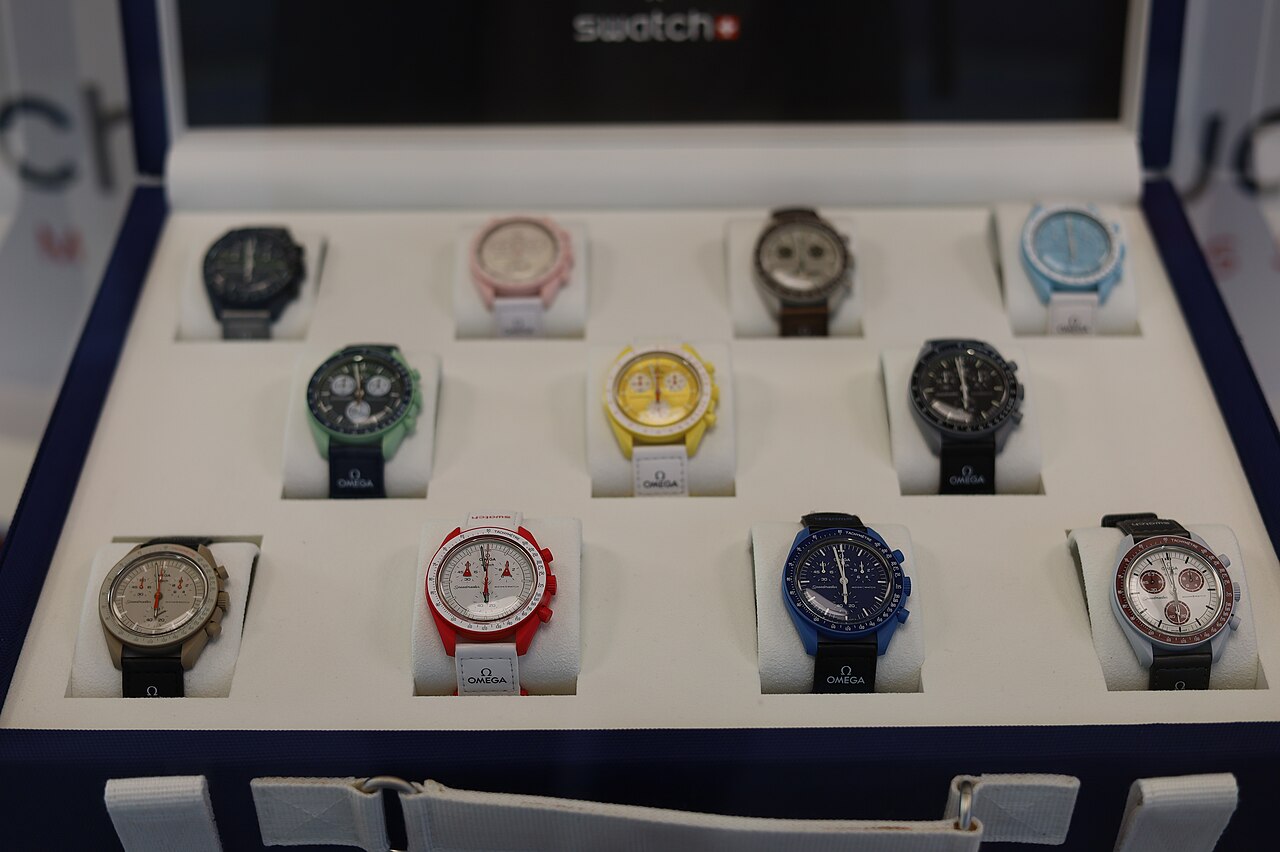
Purists clutched their pearls. Then the collection arrived on 26 March 2022: eleven watches named after bodies in the solar system, sold only in selected Swatch stores. In Hong Kong, hundreds queued for hours, and buyers were limited to one each.
Did it cheapen Omega? Forum commentators still argue about it, which is excellent news, since nobody argues about things they have forgotten. My view: nobody confused the bioplastic one with the steel one, and the cheap watch is an invitation into a story that ends, eventually, at a far more expensive one.
The lesson: a daring match can work if each partner knows exactly which part of itself it is lending, and which part stays locked in the safe.
The divorces
And now, the part of the column readers pretend not to enjoy.
Lego and Shell. Their relationship went back to the 1960s, and a co-promotion deal running from 2012 to 2014 put Lego sets on sale at Shell petrol stations in 26 countries. Then Greenpeace released a film showing a Lego Arctic slowly drowning in oil. It drew almost six million views.
In October 2014, Lego announced it would not renew. The product had not failed. One partner’s reputation had simply become the other’s problem, which is precisely what spillover means.
Adidas and Yeezy. Begun in 2015 and ended on 25 October 2022 after Kanye West’s antisemitic remarks, at an estimated cost to Adidas of up to US$246 million in profit that year alone. When your partner is a person, you are marrying their next interview too.
Ingredient branding: the quiet, practical marriage
Some unions are arranged marriages that run for decades.
In 1991, Intel began paying part of the advertising costs for PC makers that carried a small “Intel Inside” logo on their machines and in their adverts. By the end of 1992, more than 500 manufacturers had signed up. Buyers who could not tell one beige box from another learned to look for the sticker.
This is ingredient branding: one brand lives inside another’s product and vouches for it. It is less glamorous than a limited-edition collaboration, and far more durable, because it rests on a promise about quality rather than a moment of excitement.
The prenup, please
Take one thing into your next partnership meeting: write the divorce before the wedding. Who owns the jointly created assets? What happens if one partner is caught in a scandal? How does either side leave, and who keeps the customers?
Then settle the small frictions too. When Spotify and Uber announced in November 2014 that riders in ten cities, Singapore among them, could play their own music in the car, drivers had to opt in and kept control of the volume. Imagine the arguments otherwise. That little clause is a prenup in miniature.
None of this is unromantic. It is what lets two brands relax enough to be bold.
Before you say “I do”
What is the difference between co-branding and co-marketing?
Co-branding puts both brand names on a shared product or service, such as Doritos Locos Tacos. Co-marketing is a joint promotion, such as a shared campaign or bundled offer, where each company keeps selling its own products separately.
What are the main risks of co-branding?
The biggest risk is reputational spillover: if one partner suffers a scandal or a quality failure, the other is tarred by association, as Lego found with Shell. Other risks include unclear ownership of customer data, mismatched audiences and demand that outstrips supply.
How long should a co-branding partnership last?
There is no fixed term. Limited-edition collaborations often run for weeks, while partnerships built around a shared customer need, such as Nike and Apple’s running products, can last a decade or more if both sides keep benefiting.
If you are planning a brand partnership and would like someone to read the vows before you sign, we’re happy to help you plan the wedding.






