Open the file and correct the label on the folder first. People search for “TWG Tea Hong Kong vs TWG Tea Singapore” as though a franchise fell out with its parent. No such quarrel exists. The Hong Kong shops and the Singapore shops belong to the same company and sell the same tins.
The fight was with someone else entirely. A Hong Kong coffee and tea wholesaler, Tsit Wing, had been trading since 1932 and had been using the initials TWG on its products for years before the Singapore brand arrived. The TWG Tea Hong Kong case is a trademark and passing-off dispute in which Hong Kong courts, between 2013 and 2016, ruled that Singapore’s TWG Tea infringed the “TWG” marks of local wholesaler Tsit Wing, forcing the brand to trade as Tea WG.
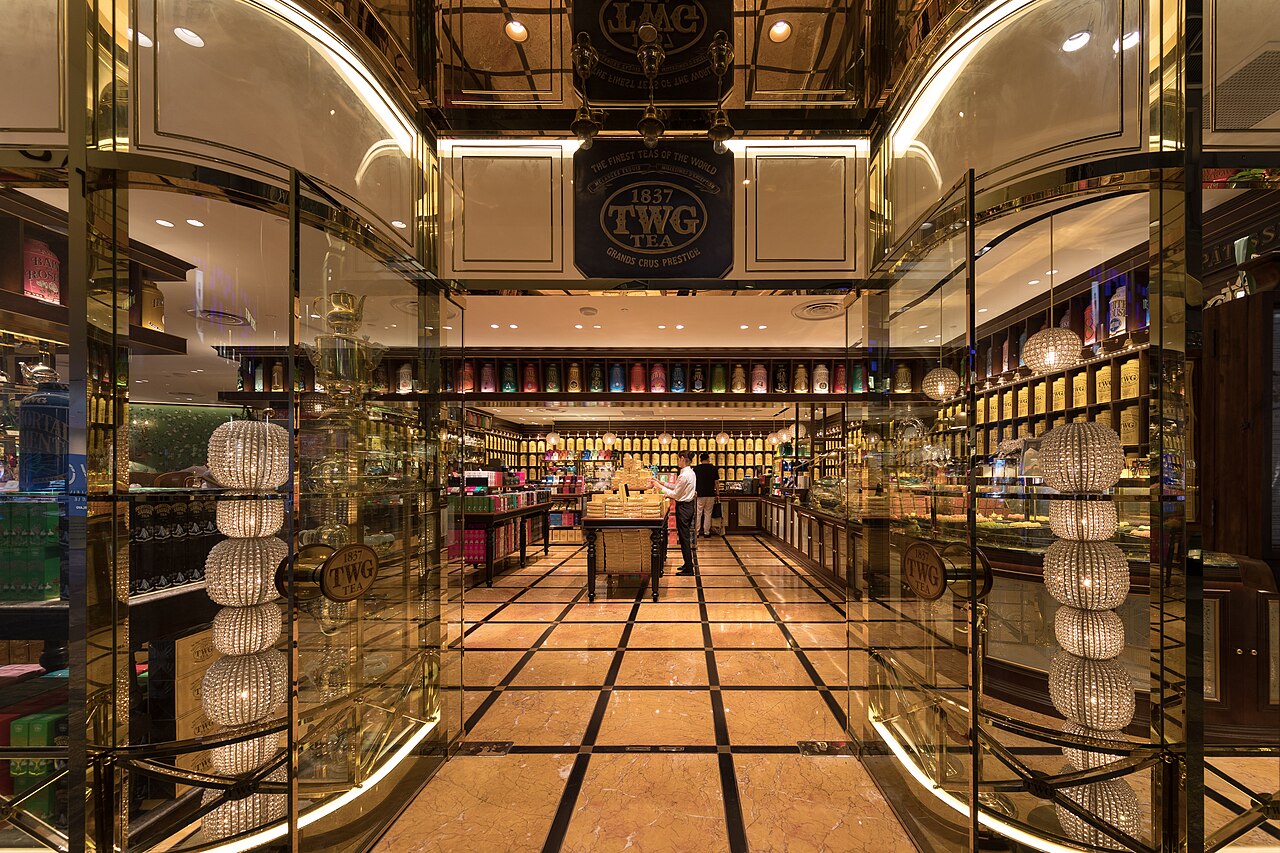
That is why the gold lettering at IFC Mall in Central reads differently from the boutique at ION Orchard. Same tea. Different name.
The reasons deserve an afternoon of any founder’s time. The mistake at the centre of this file is common, quiet and fixable long before anyone instructs counsel.
The parties
The claimant group. Tsit Wing traces its Hong Kong business back to 1932, when it began as a wholesaler of tea and coffee. Three generations later it was in food service and supermarkets, and had run TW Coffee Concept cafés between 1994 and 2009.
In 2006 it adopted a logo built from the initials of “Tsit Wing Group”: the letters TWG beside a set of concentric ovals. It registered those marks for goods including tea, coffee and sugar, and put them on packaging and invoices across the territory.
The defendant group. TWG Tea Company Pte Ltd was incorporated in Singapore in 2001 and adopted the TWG name in 2008, when the initials stood for “The Wellness Group”. Its first Tea Salon and Boutique opened at Republic Plaza in August 2008, the second at ION Orchard a year later.
The brand was conceived by Manoj Murjani with tea specialist Taha Bouqdib, and it was built from day one as a luxury proposition: hundreds of teas, black-and-gold packaging, salons designed to feel like a grand hotel’s tea room.
TWG Tea’s own tour of its Marina Bay Sands salons: the black-and-gold theatre that survived a forced rename in Hong Kong.
The intersection. On 8 December 2011, TWG Tea’s Hong Kong company opened a salon and boutique at IFC Mall. It used two signs.
One was a cartouche containing “1837 TWG TEA”. The other was a balloon device with “TWG TEA” and the words “PARIS SINGAPORE TEA”.
The facts that mattered
A luxury salon and a wholesaler supplying supermarkets do not look like competitors. That was, roughly, the defendant’s instinct. The courts started from the other end.
Five witnesses told the trial court they had assumed the IFC shop was a Tsit Wing venture. The judge accepted their belief was genuine. He went further and found that use of “TWG” by the newcomer made confusion and deception inevitable among people who knew the wholesaler’s mark, including purchasers whose first language was Chinese.
Then came the question of harm. Tsit Wing had never run a tea salon. But it sold tea, it had run cafés, and the court found it could reasonably expand into neighbouring fields. Damage could arrive directly, through tea sales diverted from supermarket shelves, or less visibly, through an unwanted association between Tsit Wing’s mark and a business it did not control.
Nobody suggested TWG Tea copied anything on purpose. Its initials simply meant something else already, in one city, to the people who mattered.
Procedural history
- July 2013, Court of First Instance. Deputy High Court Judge Saunders found for Tsit Wing on both passing off and infringement under section 18(3) of the Trade Marks Ordinance, and ordered costs on an indemnity basis.
- October 2014, Court of Appeal. Vice-President Johnson Lam, sitting with Justices Barma and McWalters, dismissed TWG Tea’s appeal, finding a high degree of similarity between the marks and between the goods and services involved. The injunction requiring the brand to stop trading as TWG in Hong Kong stood, with modest changes to its wording.
- 29 January 2016, Court of Final Appeal. A five-judge bench led by Chief Justice Geoffrey Ma unanimously dismissed the final appeal. The leading judgment was written by Justice Gummow, a retired judge of the High Court of Australia. It was the first trademark infringement case that court had heard.
Somewhere in that sequence, the Hong Kong subsidiary formerly called TWG Tea (HK) Company Limited became The Wellbeing Group (HK) Company Limited. On the high street, the brand became Tea WG.
What did the courts actually decide?
The final judgment’s points sound dry. They are intensely practical for anyone designing a brand.
Similarity and confusion are two questions, not one. Under the Hong Kong ordinance, a court first asks whether the signs are similar, then whether that similarity causes a likelihood of confusion. TWG Tea’s argument blended the two: the marks might look alike, it said, but the luxury context of its salons meant nobody would be misled. That framing did not survive.
A logo is judged as a whole, but dominant features count. The court rejected the idea of stripping a mark down to its loudest element and ignoring the rest. It equally refused to pretend the shared letters were incidental. In both groups’ marks, “TWG” did the heavy lifting.
Colour can work against you. Tsit Wing had registered each mark in a coloured and a greyscale version as a series. The consequence was that colour could not be treated as a distinctive part of its registration. A small filing decision, years earlier, shaped how the marks were compared.
Spoken comparison matters less than it did. Older English cases leaned heavily on how marks sound aloud, a habit from an era of shop counters and verbal orders. The court treated that emphasis as a relic of older ways of retailing. Modern shoppers mostly see before they say.
Dilution, the American way, is not Hong Kong law. The court declined to import the US idea that a famous mark can be harmed merely by being blurred, with no deception involved. Tsit Wing won anyway, because the trial findings showed real deception among people who knew its mark. Protecting goodwill in related fields did the work.
Fair to both sides
A case file that only flatters the winner is not much use, so here is the defendant’s position at its strongest.
TWG Tea did not borrow a famous name. Its initials had an honest origin. It traded in a different register, with salons, afternoon tea and gift tins priced for the luxury end, and it could reasonably argue that a shopper in a marble-floored mall would not mistake it for a supplier of catering coffee.
It fought on genuine points of law, all the way up. The questions were open ones, which is why the final judgment matters well beyond these two companies.
The claimant’s position is simpler. It had used the letters first, in that city, on the same category of goods, and had registered them. A newcomer walked into its market and, on the evidence, confused some of its customers. Trademark law exists for exactly that situation.
Both things are true. The system protected the party that was there first. That is its job, and it does not grade on intent.
Why does a brand have different names in different countries?
Because trademarks are territorial. A registration in Singapore protects you in Singapore. It does not travel with your stock, your website or your Instagram following. Each market is a fresh field, and somebody may already be standing in it.
Goodwill now spreads across borders online. Registration and enforcement still stop at them. Brands live in both worlds at once.
TWG Tea is in long, distinguished company:
Burger King in Australia. When Jack Cowin took the Australian franchise in 1970, he found an Adelaide drive-in had already registered the name. He picked Hungry Jack’s from a list of alternatives the parent company supplied.
The local trademark lapsed in 1996. Yet by 2003 the Burger King outlets that had opened in the meantime were rebadged as Hungry Jack’s. The workaround outlived the problem.
Budweiser in Europe. The American brewer and the Czech brewery Budějovický Budvar have argued over the name since the early twentieth century, across more than a hundred cases. Where the Czechs hold the rights, the American beer sells as Bud. In the United States, the Czech beer sold for years as Czechvar.
The iPad in China. Apple launched a tablet into a market where a display maker, Proview, held the iPad trademark. The dispute ended with Apple paying Proview US$60 million.
The iPhone in Brazil. Gradiente filed to register “iphone” with Brazil’s trademark office in 2000, years before Apple’s handset existed, and later sold its own Android phones under the name.
None of these names was lost for lack of brand strength. They were lost to calendars and filing cabinets.
Is it a disaster to trade under a different name in one market?
Not necessarily. Some of the world’s biggest brands choose it.
Unilever’s ice cream carries one heart-shaped symbol across dozens of countries and a different word under it almost everywhere: Wall’s in Britain, Streets in Australia, Selecta in the Philippines, Kwality Wall’s in India, Ola in South Africa, Miko in Egypt and Morocco. The symbol carries the global meaning; local names carry the local affection. That is brand consistency of a disciplined kind: one system, many surfaces.
TWG Tea had the advantage of a strong visual identity to fall back on. Walk into a Tea WG shop and the yellow artisanal tins, the gold-on-black packaging and the theatre of the tea wall are all present. In 2023 the brand opened a refurbished IFC concept store under the Tea WG name, built around a takeaway menu of more than a hundred teas. If the business had depended on the three letters alone, the injunction would have hurt far more.
The real cost of a forced rename is friction. Search gets messier. Visitors wonder whether the Hong Kong shop is a licensee. Every regional campaign needs a footnote.
None of it is fatal. All of it is avoidable.
The quieter credibility question
Two other details sit in this file, and both concern the gap between what a brand says and what a customer infers.
First, the date. The logo that went to court carried “1837”. The company explains it as a nod to the year Singapore became a trading post for tea, spices and fine goods.
Yet at trial in 2013, the judge noted that the date had led people to believe the company was founded then. It was founded in 2008. Heritage cues are powerful precisely because customers take them literally. Use them only where the literal reading also holds, or be very clear about what they mean.
Second, the initials. They began as The Wellness Group. Today the company says TWG stands for The Wellbeing Group, the vehicle co-founder Bouqdib established after a separate ownership dispute. TWG Tea now sits within V3 Gourmet, part of Ron Sim’s V3 Group, whose OSIM first bought into the brand in 2011.
Initials that can quietly change their meaning are flexible. They are also, as the Hong Kong courts showed, only as defensible as their history in each market.
Lessons for brands crossing borders
- Search every market before the lease, not after. Clearance searches cost a fraction of one hearing. Include acronyms, initials and transliterations, because those are where collisions hide.
- Treat initials as a risk class. Three-letter names are short, memorable and almost impossible to own outright. Somewhere, a family firm has used the same letters for decades.
- Look at the category, not only the competitor set. A luxury salon and a catering wholesaler were, to the courts, two businesses selling tea under the same letters. Your positioning does not set the boundaries of the market; the law and the customer do.
- Register your identity in the forms you actually use. Colour, greyscale, symbol, wordmark, local-language versions. Filing choices made today decide how your marks are compared in ten years.
- Build assets that survive a rename. A distinctive tin, a signature colour, a shape, a ritual. If the name is the only thing customers recognise, a court order can erase you from a market overnight.
- Audit your heritage claims. Every date and city in your logo should survive a literal reading.
Quick answers
Why is TWG Tea called Tea WG in Hong Kong?
Hong Kong courts found that TWG Tea’s signs infringed the registered “TWG” marks of Tsit Wing, a local coffee and tea wholesaler founded in 1932. The final appeal was dismissed in January 2016, so the Singapore brand trades there as Tea WG.
Is Tea WG in Hong Kong the same company as TWG Tea in Singapore?
Yes. Tea WG is the same Singapore-based luxury tea brand, selling the same teas; only the name used in Hong Kong is different.
What does the case teach brands expanding overseas?
Trademark rights are territorial, so a name protected at home can be owned by someone else abroad. Clear every target market, including initials and translations, before you open.
The fastest way to avoid becoming a case file is to check the ground before you build on it; if you’re taking a Singapore brand overseas, here’s how we help companies prepare their brand for new markets.






