Watch the start of any big-city marathon from the pavement and you will see something odd. Thousands of runners, barely a face you know, and yet you could name the brand on almost every foot.
A tick. Three stripes. A tiger’s crossed lines. A shoe so thick-soled it looks like a dare.
That is the whole game in one frame. Sports brands sell a product most people could not tell apart blindfolded, and they make it instantly recognisable at a jog.
Sports brand branding is the work of turning athletic footwear, apparel and equipment into symbols of performance and identity, using logos, athletes, slogans and technology stories so that people choose a brand for what it says about them, not only for how it performs.
What follows is a scouting report on the main contenders: how they built their brands, where they slipped, and what the rest of us can learn.
Why do sports brands matter more than the shoes?
Because the shoe is only half the purchase.
A running shoe is a piece of foam, rubber and mesh. A good one makes a difference over 42 kilometres. But most sports shoes are never raced, and a large share are worn to the office, the mall or the school gate.
What people buy, in those cases, is membership. A brand tells everyone, including the wearer, which tribe they belong to and what they aspire to.
Ask people who sell or wear the stuff and the same truths come up. Cyclists pick the kit they identify with even when a shop assistant swears the alternative is just as good. Sceptics wonder whether fast race times come from the shoe or from the sponsorship deal.
Runners grumble that sizing is chaos across brands, except for the one they trust to fit every time. All of that is about brand, not foam.
That does not mean product is irrelevant. The biggest name in the sport learned the hard way that forgetting the product is the fastest route to losing ground.
Nike: a wing, a phrase and a tribe
Nike began in 1964 as Blue Ribbon Sports, founded by the coach Bill Bowerman and his former runner Phil Knight. In 1971 a graphic design student at Portland State University, Carolyn Davidson, drew a mark for the young company and was paid $35.
The Swoosh, often read as the wing of the Greek goddess of victory, became one of the most valuable small drawings in commerce. In 1983 Knight thanked Davidson with a gold Swoosh ring and shares in the company.
In 1988 the agency Wieden+Kennedy gave the brand its line. “Just Do It” told you nothing about shoes and everything about attitude, which is exactly why it travelled. Dan Wieden later credited a far darker source: the last words of a man facing execution.
Nike’s own ‘Why Do It?’ film reintroduces Just Do It to a new generation, proof of how long an attitude line can run.
For three decades Nike’s formula was simple to describe and fiendishly hard to copy. Sign the defining athletes. Tell stories about struggle and victory. Back them with genuine product innovation.
When Nike marked the slogan’s 30th anniversary in 2018 with “Dream Crazy”, featuring Colin Kaepernick, it triggered boycott calls from some and fierce loyalty from its core audience. The brand chose its tribe out loud.
Why did Nike lose ground?
From 2020, under chief executive John Donahoe, Nike reorganised around men’s, women’s and kids’ divisions rather than specialist sport categories. It pushed hard towards selling directly to consumers online and pulled back from many wholesale partners. Marketing tilted towards digital, data-driven activation.
Critics inside and outside the company argued that the specialist knowledge behind great running and football products was diluted. Retailers’ shelves filled with rivals, and discounting crept in.
By mid-2024 Donahoe was admitting that Nike had leaned too far away from wholesale, and the share price fell sharply after weak results. In October 2024 Elliott Hill, who had joined Nike as an intern in 1988, came out of retirement to take over as chief executive.
The lesson is not that Nike’s brand failed. It remains, by Brand Finance’s 2025 measure, the strongest apparel brand in the world. The lesson is that even the strongest brand needs a product engine and broad distribution feeding it.
Brand is a multiplier. Multiply zero and you still get zero.
Adidas and Puma: two brothers, two brands
The rivalry that shaped European sport started in one house. Adolf “Adi” Dassler and his brother Rudolf made sports shoes together in Herzogenaurach, Bavaria, until they split after the Second World War. Adi registered Adidas in 1949. Rudolf first called his company Ruda, then Puma.
Adidas’s most famous asset was bought, not invented. In 1952 the company acquired the three-stripe mark from the Finnish brand Karhu, reportedly for two bottles of whisky and a modest sum. Few brand investments have paid back so handsomely.
The Trefoil followed, designed in 1971 and launched in 1972, and was later replaced as the main logo by a mark built from the stripes themselves.
The 2004 campaign “Impossible is Nothing” gave Adidas a line to rival Nike’s. More recently, the brand has learned how fast a partner can become a liability. It cut ties with Kanye West after his antisemitic remarks, giving up a lucrative line to protect the core brand.
Meanwhile the Samba, a retro football trainer, is now counted as its most successful shoe. Proof that heritage products can carry a brand when the hype cycle turns.
Puma has always been the provocateur. In 1970, the two family companies reportedly agreed not to sign Pelé. Puma signed him anyway and paid him to tie his boots on camera before Brazil’s World Cup quarter-final against Peru.
Three decades later it dressed Cameroon’s national team in a sleeveless shirt at the 2002 Africa Cup of Nations, then a one-piece kit in 2004 that FIFA ruled illegal. The governing body even docked Cameroon six World Cup qualifying points before restoring them. As football regulation, it was a mess. As brand theatre, it was unmistakably Puma.
In January 2026 China’s Anta Sports agreed to buy roughly 29% of Puma for about €1.5 billion, becoming its largest shareholder. Which brings us east.
Asics: a sound mind in a sound body
Asics began in Kobe in 1949, when Kihachiro Onitsuka started making basketball shoes. The name came later, in 1977, when Onitsuka Tiger merged with two other companies. ASICS is an acronym of the Latin anima sana in corpore sano, a sound mind in a sound body.
It is a rare thing: a brand name that is also a philosophy. It gives Asics permission to talk about mental wellbeing as naturally as about cushioning, which suits a generation that runs as much for the head as for the legs.
Asics also shows how to run two brands from one history. Its crossed “Tiger Stripes”, first seen on the Mexico 66 design, mark its performance shoes. The Onitsuka Tiger name carries a fashion-led line of retro designs, drawn from the company’s 1970s to 1990s archive and relaunched as lifestyle products in 2015.
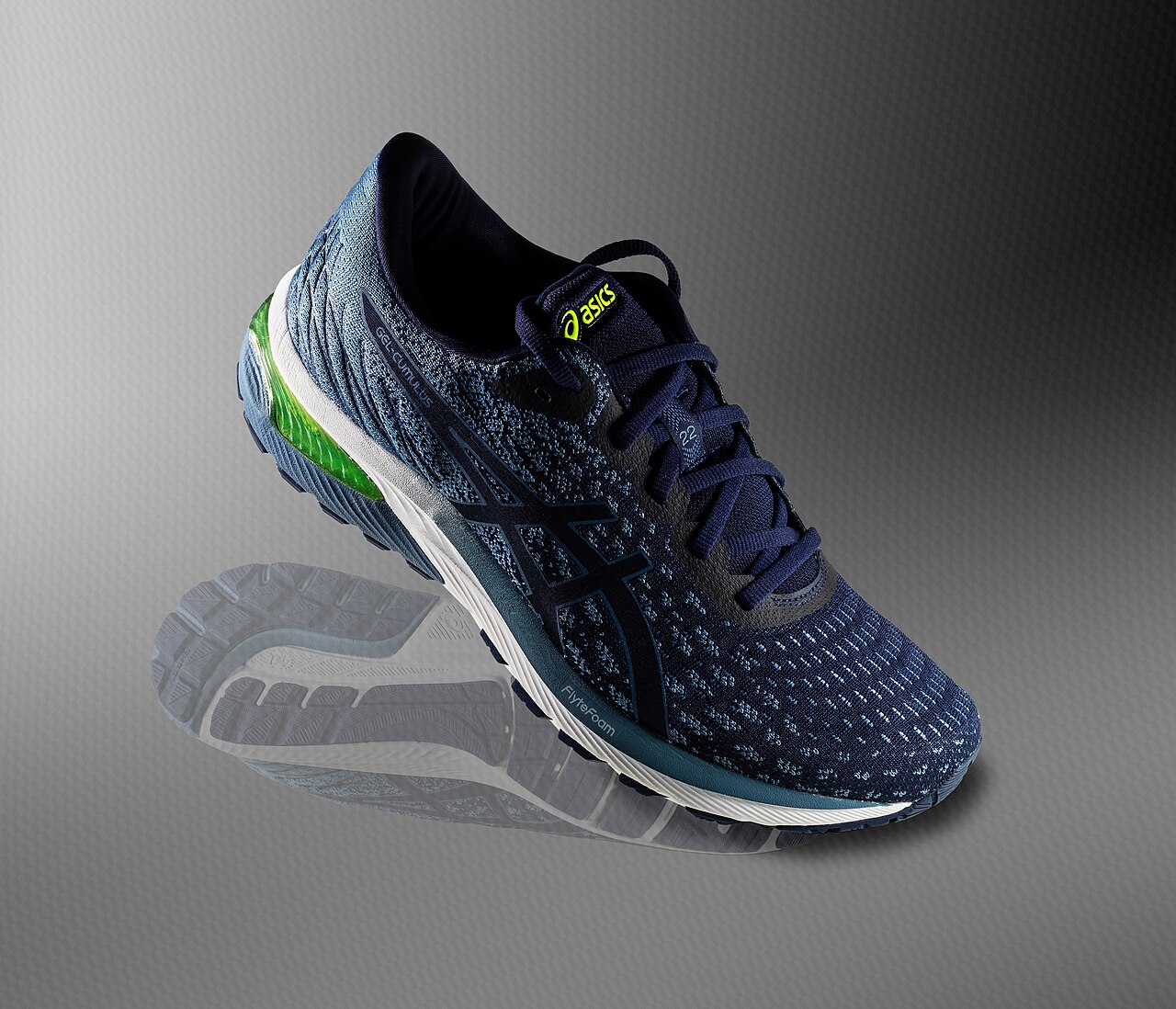
One company, two audiences, no confusion. A runner chasing a personal best and a teenager chasing a vintage silhouette are buying from the same Kobe story.
Anta and Li-Ning: China’s champions find their voice
Li-Ning was founded in 1990 by Li Ning, the gymnast who won three gold medals at the 1984 Los Angeles Olympics. A founder with a medal-winning story is a powerful start.
At the 2008 Beijing Olympics, Li Ning lit the cauldron in front of a global audience, though his company was not the official sportswear sponsor. That moment did more for the brand than many sponsorships could.
Its path since then is a lesson in repositioning. A 2010 revitalisation brought a new logo and a slogan translated as “Make the change”, aimed at younger consumers. It did not land, and the company went through years of heavy losses.
The turnaround came from a different direction. In 2018 Li-Ning showed at New York Fashion Week with collections splashed in red and yellow and bold Chinese characters. That year became known as the first year of guochao, the “national tide” trend in which Chinese brands draw confidently on Chinese culture.
Li-Ning stopped trying to look like a Western brand. It started looking proudly like itself.
Anta took a different route: scale and portfolio. Founded in 1991 by Ding Shizhong and headquartered in Jinjiang, Fujian, it acquired Fila’s business in mainland China, Hong Kong and Macao in 2009. It led a consortium that bid for Amer Sports in late 2018, bringing Arc’teryx, Salomon and Wilson into its orbit.
It has signed NBA names, including Klay Thompson in 2017 and Kyrie Irving, whose Anta signature shoe launched in 2024. And then came the Puma stake.
Brand Finance ranked Anta China’s strongest apparel brand in 2025. Its strategy reads like a house of brands built at speed: a mass-market Chinese core, plus a stable of global names, each kept distinct. Whether Western consumers will ever buy Anta-branded shoes in volume remains open. They may already be buying Anta-owned brands without knowing it.
Can new brands still break in?
Yes, and On and Hoka prove it.
Hoka was founded in Annecy, France, in 2009 by Nicolas Mermoud and Jean-Luc Diard, both formerly of Salomon. At a time when the running world was obsessed with minimalist, barefoot-style shoes, Hoka went the opposite way with towering, heavily cushioned midsoles.
It looked like a contrarian bet. Comfort turned out to be a brand. Deckers Brands bought Hoka in 2013, and the name was shortened from Hoka One One to Hoka in 2021.
On came out of Switzerland, incorporated in January 2010 by former Ironman champion Olivier Bernhard with David Allemann and Caspar Coppetti. Its CloudTec soles, with visible hollow pods, are a branding gift: you can see the technology from across the street.
Roger Federer became a shareholder in 2019, giving the brand a Swiss icon associated with precision and grace rather than raw aggression. The company listed in New York in September 2021.
Both brands broke the category rule that sports branding must be about winning. They sold feeling: comfort, lightness, a quieter kind of performance. And both grew partly in the space Nike left on retailers’ shelves when it stepped back from wholesale. On, Hoka, New Balance and Asics were the names shoppers turned to.
Picture a 45-year-old accountant in Singapore choosing her first marathon shoe. She is not trying to be an Olympian. She wants to finish without injury and to look like she belongs at the start line. The challenger brands spoke to her first.
What do athlete endorsements actually buy?
More than vanity.
Endorsement effects on share prices have been understood for years. The sales effect is harder to pin down, but it is real. Between 2000 and 2010, Tiger Woods’ endorsement is estimated to have brought Nike’s golf ball business around $103 million in extra profit and a price premium of roughly 2.5%.
Some of that came from pulling golfers away from rival balls, and some from growing demand for premium balls overall. Even so, the ball sales alone recovered only a little over half of what Nike paid him. The rest of the value had to come from everything else he wore.
The practical takeaways for any sports brand are plain. Choose athletes whose story matches the brand’s promise. Stay with them through slumps, where it makes sense, because loyalty is part of the story. And plan for the day a star becomes a risk, because sooner or later one will.
The playbook, stripped down
Look across these brands and a pattern emerges that applies well beyond sport.
A simple symbol, used relentlessly, becomes worth more than almost any campaign. The Swoosh and the stripes are proof.
A line that captures an attitude outlasts one that describes a product. Nobody remembers a sports slogan about foam density.
Heritage is a reservoir, but only if you draw from it. Adidas’s Samba, Asics’s Onitsuka Tiger and Li-Ning’s red-and-yellow revival all turned history into growth.
Product and distribution are part of the brand. Nike’s recent years show what happens when they are treated as separate.
And challengers win by changing the question. Hoka and On did not try to out-Nike Nike. They asked runners how they wanted to feel, then built a brand around the answer.
Final whistle: quick answers
What is the strongest sports brand in the world?
Nike is widely regarded as the world’s leading sports brand, and Brand Finance named it the strongest apparel brand globally in 2025, with Adidas among the fastest-growing apparel brands that year.
What does ASICS stand for?
ASICS is an acronym of the Latin phrase anima sana in corpore sano, meaning “a sound mind in a sound body”. The name was adopted in 1977 when Onitsuka Tiger merged with two other companies.
Who owns Puma?
Puma is a listed German company. In January 2026 China’s Anta Sports agreed to buy a stake of about 29% for roughly €1.5 billion, making it Puma’s largest shareholder.
If you want your brand to be recognised at a glance from the side of the track, our brand strategy team can help you build the playbook.






