Somewhere in your memory, right now, is a portly white figure made entirely of tyres. You have never met him. He has never sold you anything directly.
He is, if we are being honest, slightly alarming to look at for too long. And yet if he turned up at your door you would probably offer him tea.
That is the whole mystery of brand mascots in one awkward visit.
A brand mascot is a recurring character, human, animal or entirely invented, that a company creates or adopts to personify its brand, so that people remember, recognise and warm to the business through a face rather than a logo.
Simple to define. Weirdly hard to explain why it works.
I have a soft spot for them. Every one is a small act of corporate optimism: a room of serious adults agreeing that the quarterly plan really needed a bunny with a drum. Let us take them seriously, then. Mostly.
Why does a cartoon earn more trust than a chief executive?
Start with the tyre man, because he started first. At an exhibition in Lyon in 1894, Édouard Michelin looked at a stack of tyres on the family stand and saw, apparently, a man without arms. Most of us would have seen a stack of tyres. That is why most of us do not run tyre companies.
Four years later, his brother André met the cartoonist Marius Rossillon, who signed himself O’Galop, and the figure was born on a poster. The original Bibendum raised a glass full of nails and broken bottles, the joke being that a Michelin tyre “drinks” the obstacle.
Michelin tells the story of its own mascot, from O’Galop’s 1898 poster to the Bibendum of today.
His name came from a line of Horace, nunc est bibendum, “now is the time to drink”. So the world’s most famous tyre mascot is a Latin drinking pun who smoked a cigar and wore pince-nez. Brand strategy in 1898 had a looser compliance process.
Here is the clever bit. A tyre is a deeply boring object. It is round, black and you only think about it when it fails. Michelin gave that boredom a personality, and a personality is something you can like, remember and, above all, trust.
That last word matters more than it sounds. A character’s features shape how people feel about a brand largely by building trust in the character itself, and the effect is strongest among people who know the brand least.
Read that again with your marketing hat on. A mascot does its hardest work on strangers. It is the friendly face at the door for people who have never been inside.
The founder who became a costume
Sometimes the mascot was a person first. Harland Sanders was a real man, born in Indiana in 1890, who was made an honorary Kentucky Colonel in 1935. The title involved no military service whatsoever. He simply looked the part, and he kept looking it.
In 1964 he sold Kentucky Fried Chicken for $2 million to a group of investors and stayed on as a salaried ambassador. In other words, he sold the company and kept the face. The buyers understood, quite correctly, that the white suit and the goatee were worth as much as the recipe.
Sanders died in 1980. His image did not. In 2015 KFC brought the Colonel back as a role, played first by the comedian Darrell Hammond and, within months, by Norm Macdonald, with a rotating cast after that. They turned a dead founder into a part, like Hamlet, and let different actors have a go.
It works because the Colonel had long since stopped being a biography and become a costume. Costumes are durable. They do not age, and anyone with the right moustache can step in.
There is a lesson there for founder-led businesses. If your own face is the brand, the brand is mortal. Turn the face into a character and you buy it time.
When your mascot is a parody of someone else’s
Not every great mascot is born from inspiration. Some are born from cheek.
In 1973 Duracell aired an advert featuring a drumming bunny. Fifteen years later, Energizer answered with a drumming bunny of its own, one who simply would not stop. The first Energizer Bunny ad aired on American television in 1988, and it was openly a parody of the Duracell one.
The parody became more famous than the original. Then came the lawyers. A confidential settlement in January 1992 split the world: Energizer got exclusive bunny rights in the United States and Canada, Duracell got them nearly everywhere else.
Which is why a traveller can leave Toronto with one bunny in their head and land elsewhere to find a different bunny entirely, both of them drumming, both of them suspiciously energetic. Fresh litigation followed in 2016, which tells you what a cartoon rabbit is worth to a battery company.
The moral is not “copy your competitor’s mascot”. It is that a character is an asset with borders, and those borders need drawing early. Trademark it, in every market you care about, before a rival with a drum does.
The lion who quit
Now to Singapore, where mascots have done something rarer than selling products. They have tried to change behaviour.
Singa the Lion arrived in 1982 as the face of the National Courtesy Campaign, designed in about six weeks by a small team of government artists. For decades he smiled from campaign posters urging Singaporeans to be more gracious to one another. When the campaign was folded into the Singapore Kindness Movement, Singa moved with it.
Then, in May 2013, he resigned. Publicly. In an open letter.
The lion explained that he needed a long break and was tired of an increasingly disagreeable society. The announcement made the mainstream news, and the movement’s leadership later insisted it was not a publicity stunt.
Whatever you call it, it was brilliant character work. For three decades Singa had been the nagging uncle of public life, easy to ignore. The day he walked out, everyone noticed.
A mascot that can feel let down is a mascot people believe has feelings, and a mascot people believe has feelings can make them feel something too. Guilt, mostly. Effective, though.
A squirrel with a savings plan
Singapore’s other beloved creature is smaller and far less likely to resign. Smiley the Squirrel, originally spelt “Smily”, debuted in 1983 as the mascot of POSB’s school savings programme. The choice of animal was no accident: squirrels famously store food for later, and the bank wanted children to do the same with their coins.
He began as a brown squirrel in a tuxedo, which is a strong look for a rodent. In the 1990s he switched to overalls and appeared on children’s passbooks. In 2008 he got the makeover that produced the version kids see today.
What Smiley shows is that a mascot can carry a brand’s purpose without anyone having to say the word “purpose”. Nobody explained thrift to a seven-year-old with a pie chart. They gave the seven-year-old a squirrel.
Many Singaporeans opened their first savings account with that squirrel on the passbook, and the warmth tends to linger into adulthood. That is a customer relationship that began in primary school.
What makes a brand mascot actually work?
Plenty of mascots flop, of course. Line up the successes, though, and patterns emerge.
Give the character a world. The best characters live inside a setting with recurring situations and a cast of friends, which keeps campaigns fresh for years. Japan’s SoftBank built a long-running series of adverts around Otosan, a gruff family patriarch who happens to be a talking dog. The dog is absurd. That is the point. Artifice is allowed.
Make it the product, if you can. M&M’s are the purest case: the mascots are the sweets. Red and Yellow have been talking since the mid-1990s, voiced over the years by actors including Jon Lovitz, Billy West, John Goodman and J. K. Simmons. When the character is the thing you buy, every appearance is also a product shot.
Let it be slightly unlikeable. This surprises clients. Characters do not have to be adorable to be effective; they have to be memorable. A mascot people grumble about is still a mascot people remember.
Repeat it until you are bored, then keep going. The team will tire of the mascot years before the public does. Michelin kept its figure recognisably the same for a century, dropping the cigar along the way and slimming him down only in 1998 to match the lower-profile tyres on modern cars. Patience is a strategy.
The bear that pays for itself (by giving itself away)
If you want the most radical mascot model on Earth, go to Kumamoto in Japan.
Kumamon, a round black bear, was created by the prefectural government in 2010 for a tourism campaign tied to the new Kyushu Shinkansen line. In late 2011 he topped a nationwide vote of Japan’s yuru-chara, the gentle local mascots, with more than 280,000 votes.
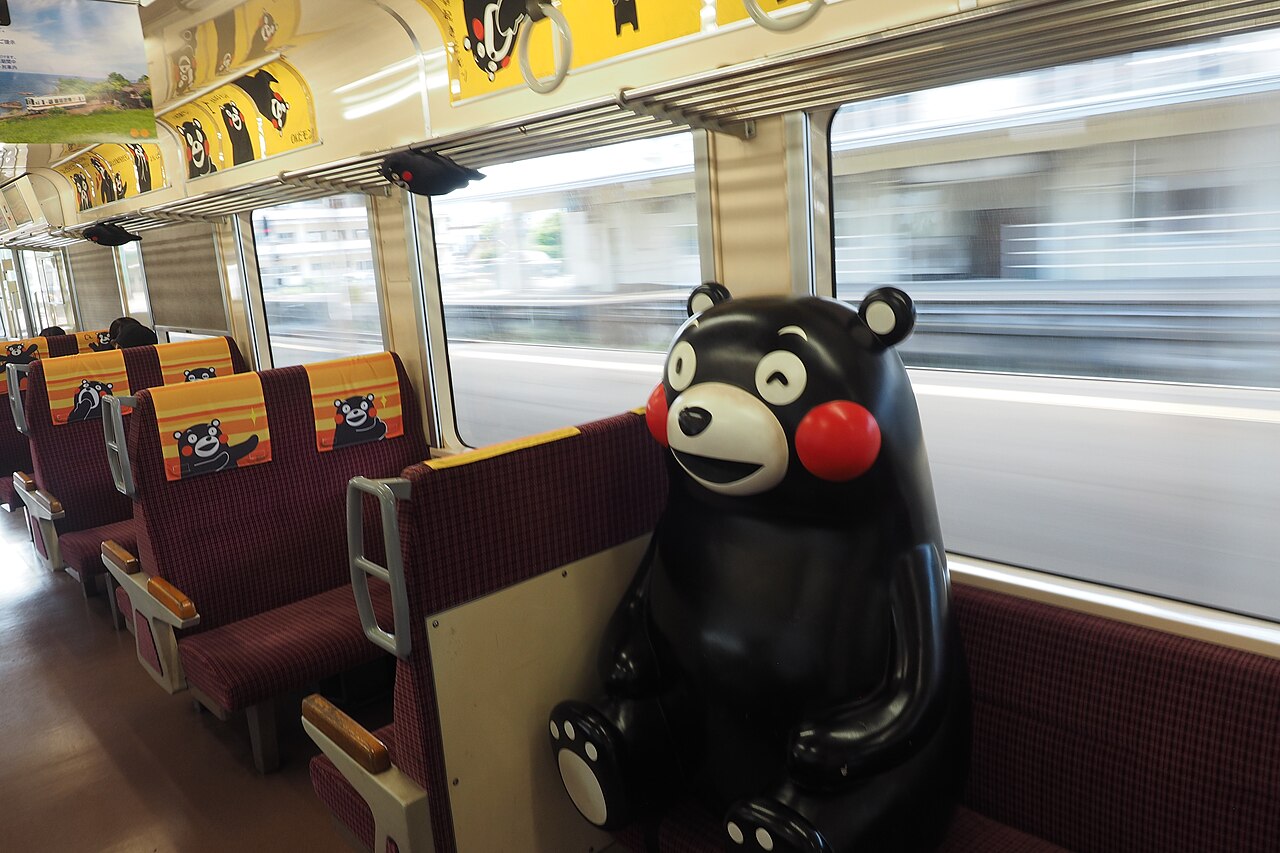
Then the prefecture did something no brand manager I know would sign off without a lie-down. It let people use Kumamon for free, as long as the products promoted goods or services from Kumamoto. Sales of Kumamon items jumped from ¥2.5 billion in 2011 to ¥29.3 billion in 2012. In 2018 the free licence was opened to foreign businesses too.
That is the mascot as an open-source platform. The prefecture gave up licensing income and got, in return, an army of unpaid salespeople putting the bear on their own packaging, every one of them advertising Kumamoto. For a place brand, which needs fame more than royalties, it was exactly the right trade.
When good mascots go through a difficult phase
In January 2022, Mars announced it was refreshing the M&M’s characters to reflect a broader range of human personalities. Green and Brown got more casual outfits. The internet, delighted to have a reason to argue about chocolate, argued.
A year later, in January 2023, Mars announced the characters were “temporarily retired” and replaced by the comedian Maya Rudolph. After the Super Bowl in February 2023, they were back.
You can read that saga two ways. One: a brand stumbled, panicked and staged a comeback. Two: a brand discovered that its characters had become so loved that their absence was itself a news event.
Both are true. A mascot that people defend is an extraordinary asset. It also means you no longer fully own it.
Should you kill your mascot? Ask an owl.
Which brings us to the most theatrical mascot moment of recent years. On 11 February 2025, Duolingo announced that Duo, its green owl, had died. Videos hinted at a Tesla Cybertruck.
Fans were invited to bring him back by completing lessons, and by 24 February the community had racked up more than 50 billion experience points. Duo climbed out of his coffin.
Online, the reaction split in a very human way. Some asked why any company would wound its own brand like that. Others called it superb marketing that had grabbed their attention all over again. Both camps had a point, and that tension is the whole trick.
Duolingo could only do this because Duo already had a personality, built over years of persistent reminders. A new mascot cannot fake its own death; nobody would attend the funeral. You earn the right to stunts by being consistent first.
Building one of your own: a quick sanity check
Picture a family-run kaya toast chain in Bedok deciding it needs a mascot. Before anyone sketches a cartoon egg, ask some honest questions.
What job will the character do? Recognition, warmth, explanation and behaviour change are different jobs that suggest different creatures. Does it grow out of something true about the business, the way Smiley grew out of saving?
Can it survive a decade of repetition without the founders tiring of it? Will it translate across languages and cultures without offending anyone, especially if the business has hopes for Jakarta or Kuala Lumpur? Who owns it, legally, in every market? And is there a world for it to live in, or just a pose for the shop sign?
Then design the rules: how it speaks, what it would never do, where it appears and where it does not. A mascot without guidelines tends to wander off and turn up, uninvited, in a slide deck wearing sunglasses. Make the character part of the identity system rather than a decoration stuck on top.
Questions people ask about mascots
What is the difference between a mascot and a logo?
A logo is a mark that identifies a brand; a mascot is a character that personifies it and can act, speak and appear in stories. Some brands, like Michelin, use the character so heavily that it effectively becomes a second logo.
Do brand mascots still work online?
Yes, because a character can post, reply and appear in short video in ways a logo cannot. In 2025 Duolingo staged the “death” of its owl mascot and revived him once users had completed enough lessons, turning a character into a global engagement campaign.
How long does it take for a mascot to pay off?
Usually years rather than months, because recognition builds through repetition. Michelin’s figure dates from 1898 and POSB’s squirrel from 1983, and both still earn their keep today.
If your brand could use a face people will happily open the door to, our brand consulting team would love to help you draw one, tuxedo optional.






